






CAMDEBOO: A DECADE YOUNG
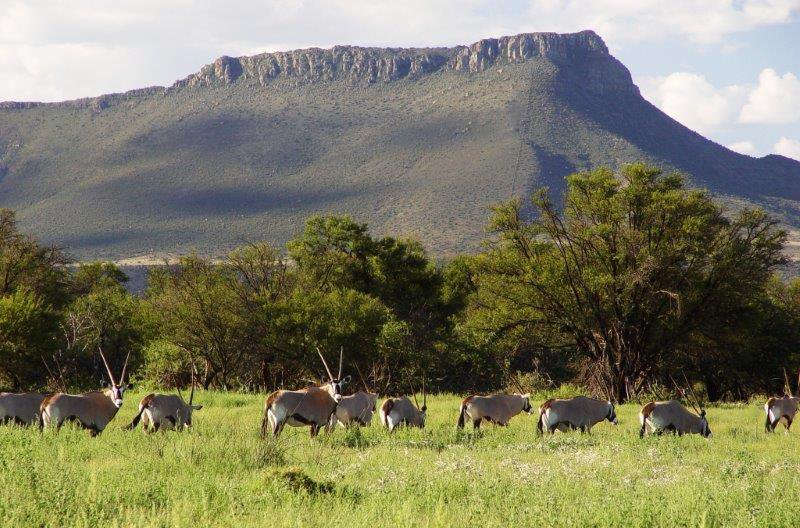
Gemsbok Herd
One of SANParks’ younger parks, Camdeboo, celebrates ten years as a national park under the management of SANParks on 30 October.
The 19 405ha Park is best known for the fact that it encompasses the world-renowned Valley of Desolation. Proclaimed a scenic national monument in 1939, it is a popular drawcard for hikers, photographer and nature lovers. The original valley road was constructed by labourers using pics, shovels and barrows. It was tarred in 1978, offering visitors easy access to a number of spectacular viewpoints along the way, culminating in a short walk to the valley itself. Here, visitors can enjoy what is also called the Cathedral of Mountains – piled dolerite columns against the backdrop of the plains of the Great Karoo. The landscape is said to be the product of erosive and volcanic forces of nature of a period of more than 100 million years.
It is also from along the valley road from where once can enjoy unique views of the historic town of Graaff-Reinet, set like a jewel within a horseshoe bend of the Sundays River. Black eagles are also known to frequent the area, from where nature lovers have a change of viewing them at close range.
Over the past decade, Camdeboo has evolved significantly from what the area was used to before. A number of activities are on offer in the Park – self-drive game viewing, 4x4 trails, a number of walking trails which allows one to explore the Park on foot, picnic sites, bird viewing from the Khwalimanzi Hide as well as a selection of water sport activities on the Nqweba Dam.
Up until the end of June, when he retired after 42 years of service in conservation, Peter Burdett was the first Park Manager at Camdeboo National Park. He automatically assumed the position after the Karoo Nature Conservation’s incorporation into SANParks, where he was the Reserve Manager.
Peter was instrumental in the planning and development of the first accommodation facilities in the Park. As recently as April 2012, Camdeboo welcomed its first ever overnight guests to the Lakeview Tented Camp and Nqweba Campsite, situated on the floodplains of the Nqweba Dam.
Over the past three-and-a half years, the rest camp, small as it may be in comparison to most others in SANParks, has received exceptionally positive feedback from overnight guests. Perhaps it is the quaintness that makes it so special…
HISTORY:
Previously known as the Karoo Nature Reserve, the area around the historic town of Graaff-Reinet in the Eastern Cape was proclaimed by former Minister of Environmental Affairs and Tourism, Marthinus van Schalkwyk. This followed an extensive process of negotiation and discussion between government, conservation groups and concerned stakeholders. The eventual decision was made possible by the World Wildlife Fund in South Africa (WWF-SA), which donated the 14 500 hectare Karoo Nature Reserve to be the centrepiece of the project.
The Karoo Nature Reserve was established in 1979 when the International Union for the Conservation of Nature and the World Wildlife Fund recognised the urgency for conservation measures in the Karoo biome and listed this action as a world conservation priority.
The early history of the Park includes use of the area by early, middle and later stone age people. Evidence of occupation by these people can be found in the form of stone age industry sites on the south eastern plains of the Park. Artefacts found in these sites include bored stones, percussion-made hand axes, scrapers, blades and grinding stones.
Khoisan hunters and herders left evidence of their occupation during the late stone age in the form of rock paintings in the eastern section of the Park.
The Inqua tribe occupied the park area during the mid 1600's, grazing their vast herds of cattle and fat-tailed sheep on the apron veld from the Camdeboo River near Aberdeen, across the Sundays River to Agter-Bruintjieshoogte near Somerset East.
White farmers settled on the Camdeboo Plains and Sneeuberg in 1770, introducing merino sheep and angora goats, as well as exotic plants. Over the years overgrazing and the effects of exotic plants have resulted in soil erosion and an increase in woody species or unpalatable plants.
Until the park was first proclaimed as a reserve in 1979, it was used as a town commonage with tenants grazing their livestock and contributing to overgrazing and erosion of some areas
















 Please wait!


