








Stadium disaster simulation a success
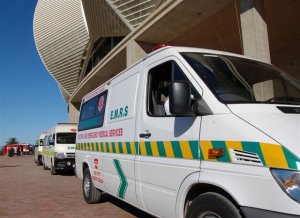
A FULL simulation of an emergency event at the Nelson Mandela Bay Stadium went off without a hitch on Saturday – flush with a huge security contingent, fire and traffic services, six ambulances, and 1400 school children, teachers and parents.
This came ahead of a flash visit by FIFA™ President, Joseph S. Blatter, Local Organising Committee chief executive Danny Jordaan and Safa boss Irvin Khoza yesterday.
“Even in the worst case scenario, as they say in Hollywood, the show must go on,” Nelson Mandela Bay Local Organising Committee security co-ordinator, Wayne Hackert, said about potential emergencies during a match at the stadium. “The aim is to de-escalate any incident as soon as possible.”
This would be achieved through a team of high-level decision-makers operating from the stadium venue operations centre, he confirmed. A group of senior, primary role-players who make up the venue operations committee – each able to make executive decisions in the event of crisis at the stadium – meet at various intervals at match days and are “mandated to take decisions” along the lines of their specific directives, said Hackert. “No-one has to phone if something goes wrong, they can all make decisions right there and then,” he emphasized.
The point of the simulation exercise was to iron out last-minute issues and challenges with just 10 days to go before the World Cup, said Hackert. An artificial crisis – in which the big screen collapsed onto the crowds – was staged in the Northeast corner of the stadium, ‘injuring’ 24 people and catapulting disaster management into action. Prior to this there were a number of other simulated incidents including a massive power outage, a reserve bank robbery, an overturned taxi on the R75 carrying fans and an overturned petrol tank, which the committee had to “deal” with.
For the simulation there were six ambulances with 12 crews, seven people in two cars from the Metro Security Services, 54 traffic vehicles with a staff of 93, six disaster management personnel and a huge contingent of 1060 Nationwide security officials. Gavin Boucher the 2010 Task Team evacuation co-ordinator said the stadium evacuation plan is rated as one of the most comprehensive in the country and had been used security template in other stadiums.
Hackert also said the stadium would be swept by a bomb squad one day before a match day and then would go into “complete lockdown”. There were also systems in place for a power outage, he said. “The stadium would switch over (to a generator) without anyone even realising the power had gone out.”
The simulation went off well, stadium officials confirmed. From a legacy perspective, 28 emergency vehicles have been added to the current Bay fleet of ambulances for the duration of the FIFA World Cup™, after which 10 will remain in Nelson Mandela Bay and 18 would be deployed around the province.
The majority of the 1400 teachers, parents and children who took part in the exercise came from Sydenham Primary School – which has had to contend with years of construction around the stadium area.
“This is a big thank you to them for putting up with all the dusty books and inconveniences. For many of them this would be the only chance to see the inside of the stadium,” said Hackert. They also received food-packs and vuvuzelas as a “small token of appreciation” from the stadium.
Author: Yithethe maAfrika
















 Please wait!


